Turf incense
A guide to Irish turf incense
Turf incense is a small sod of Irish turf, made to be lit for the smell and then left to smoulder. It is not a heater, and it is not a bag of fuel for the grate.
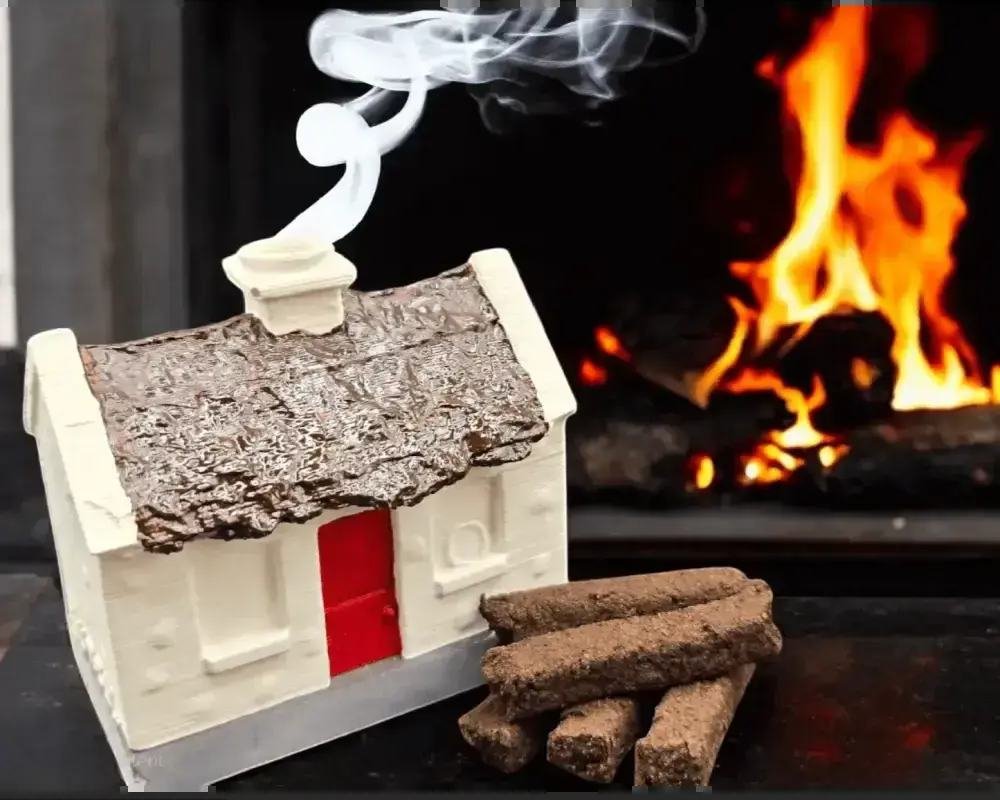
The smell described in the rest of this guide belonged to a hearth. Most houses that want it now do not have a bank of turf, a reek at the gable, or a crane over the fire. What they can have is a miniature sod, the size of a short stick of charcoal, burned on a non-combustible plate for half an hour or so. That is turf incense. Aureal Aromatics makes it on a farm in Silverbridge, County Armagh, and sells it at turfincense.com. This page is the practical guide. The shop is where the objects are.
The shop describes the pieces as miniature sods of turf, made so that they light and then smoulder, rather than as a perfume poured onto something else. A sod in the hand is dry, dark, and fibrous. Lit properly, it does not flare like a candle. It glows at one end and gives off the earthy, slightly sweet smoke of a turf fire. One sod lasts about 35 to 45 minutes. That time comes from the maker’s own instructions, and like any natural piece it will vary. A denser sod lasts longer. A draught shortens it, or lifts it into flame, which is not what you want.
What you are burning, and what you are not
You are burning a small piece of turf for the smell. You are not heating a room, and you should not try. You are also not buying a winter’s firing by the back door. Since 31 October 2022 the Solid Fuels Regulations have restricted the retail sale of turf for heating a home. The rules are set out in the history. They are about fuel. These sods are sold as incense, in counts of five, seven or twenty-four, not by the trailer. Nothing on this page is a way around that law, and nothing here is a legal opinion. If you want turf to burn in a fireplace, read the regulations and the NPWS pages, not a product listing.
The cottage, if you use one, is a cover rather than a fuel. It is cast in Jesmonite, a stone-and-resin material the maker describes as heat-resistant, and it is hand-painted. The shop says each one is a replica of a small cottage in Rathkeale, County Limerick, about 80 millimetres long, 70 wide and 55 high. It sits over the lit sod. The smoke leaves by the chimney. It is a pleasure to watch. It is still a thing sitting over a live ember, and it should be treated that way.
Lighting a sod on slate
The simplest set is a reclaimed slate and the sods. The Irish turf incense set is that: a slate, with pads on the underside to keep it from scratching or scorching the table, and seven sods. Slates are cut by hand. The shop says they vary, and that a typical one is about 8 to 10 centimetres long, roughly the size of a card. The sods vary too, about 3 to 4.5 centimetres.
Do it in this order.
- Set the slate on a steady, non-combustible spot, away from curtains, paper, bedding and anything that can swing into the smoke. The pads are there to protect the surface. If a pad is missing, do not put the bare slate on bare wood.
- Lay one sod on the slate.
- Light the tip and let it catch until the end is glowing.
- Blow the flame out gently. What you want is a smoulder and a thread of smoke, not a flame.
- Leave it. If a draught puts the flame back, blow it out again. If the sod will not stay lit, it may be damp, or it may need a more thorough glow before you blow. Do not keep a flame going “so that it works.”
- Let it finish on the slate. The maker’s time is about 35 to 45 minutes. Stay in earshot of it.
That is the whole method. There is no special breath, and no need to break the sod open.

The cottage over the sod
The cottage set adds the little house: the Jesmonite cottage, a slate, and five sods. Light the sod exactly as above, on the slate. When it is glowing and the flame is out, set the cottage over it so the smoke can rise through the chimney. Take the cottage off if you need to see whether the sod is still alive. Do not light the sod underneath the cottage and hope. You want to know it is smouldering before you cover it.
The cottage is small enough to sit on a shelf or a table. It is not a toy. The roof and the chimney get the smoke, and the body of the house sits close to the ember. Hands that do not know it is hot should not pick it up halfway through. Children can watch it. They should not feed it.
The creel
A creel, on the bog, was a basket for a heavy load: turf, seaweed or potatoes, carried on the back or, along the western seaboard, as a pair of panniers on a donkey. The National Museum describes those panniers. The word creel on the shop is a nod to that basket, not a claim that you are buying one.
The creel set holds twenty-four miniature sods, a slate with pads, and a small brown basket. The shop is frank about the basket: it is a 3D-printed replica in a brown plastic, filled and sealed so the sods stay dry, not a creel of sally rods. Twenty-four sods, at something under an hour each, is a good many evenings. It is still incense. It would not boil a kettle.

Safety
The sod is small. The rules are the same as for any smouldering fuel.
Burn it on the slate or on something else that cannot catch fire. Keep it clear of curtains, papers, sofas, beds, and Christmas greenery. Keep it where a child or a dog cannot paw it onto the floor. Do not leave the house while it is going, and do not go to sleep with it lit. Half an hour is long enough to forget a thing on a sideboard.
Open a window or a door. This is real smoke, the same family of smoke as a hearth, only much less of it. Anyone who is pregnant, very young, elderly, or who has asthma or is told to avoid smoke should treat it as smoke and not as a scented candle. Smouldering fuel can give off carbon monoxide as well as the smell you want. A small sod in a room you can air is a different risk from a hearth in a closed bedroom, and it should stay that way. Do not burn several at once to “fill the house.” One is the dose the instructions are written for.
If you need to put it out early, do not crush it into a bin while it is still glowing. Move the slate somewhere non-combustible, douse the sod until nothing red remains, and leave it until it is cold. Ash that looks dead can relight in a draught. The next sod should be a fresh one. A soaked sod will only frustrate you.
The pads, the slate and the Jesmonite house are the maker’s answer to heat on a table. They are not a reason to balance the set on a pile of books, or to use it in a caravan bunk, or to treat the cottage as a night-light.
Where it is made
The shop says the incense is made in small batches on the farm at Silverbridge, in south Armagh, and that the cottage is painted there. Ian Kelly, who runs that shop, also runs this guide. The guide is for reading. The shop is for the sods, the slate and the cottage. Prices, delivery and questions about an order belong on turfincense.com, which is also the place to write to him. There is no separate email published here, on purpose.
If you have never smelled a turf fire, start with one sod on a slate and decide whether the smell means anything to you. If you grew up with it, you will know in the first minute. The longer story of why that smell was in so many kitchens is the hearth, and the story of how the sods were won is cutting and saving.
Sources and further reading
- Aureal Aromatics, the cottage burner set, including lighting steps, materials and dimensions: turfincense.com
- Aureal Aromatics, the slate burner and seven sods: turfincense.com
- Aureal Aromatics, the creel set: turfincense.com
- Air Pollution Act 1987 (Solid Fuels) Regulations 2022, for the rules on selling turf as heating fuel: irishstatutebook.ie
- Department press release on those regulations: gov.ie
- National Museum of Ireland, on the donkey panniers that were the working creel: museum.ie