A guide to Irish turf

The smell of Irish turf

For generations, turf cut from the bog warmed Irish kitchens and sat in the grate of the hearth. This is a guide to that fuel: how it was cut and saved, how it burned, and how the smell of it can still be brought home.
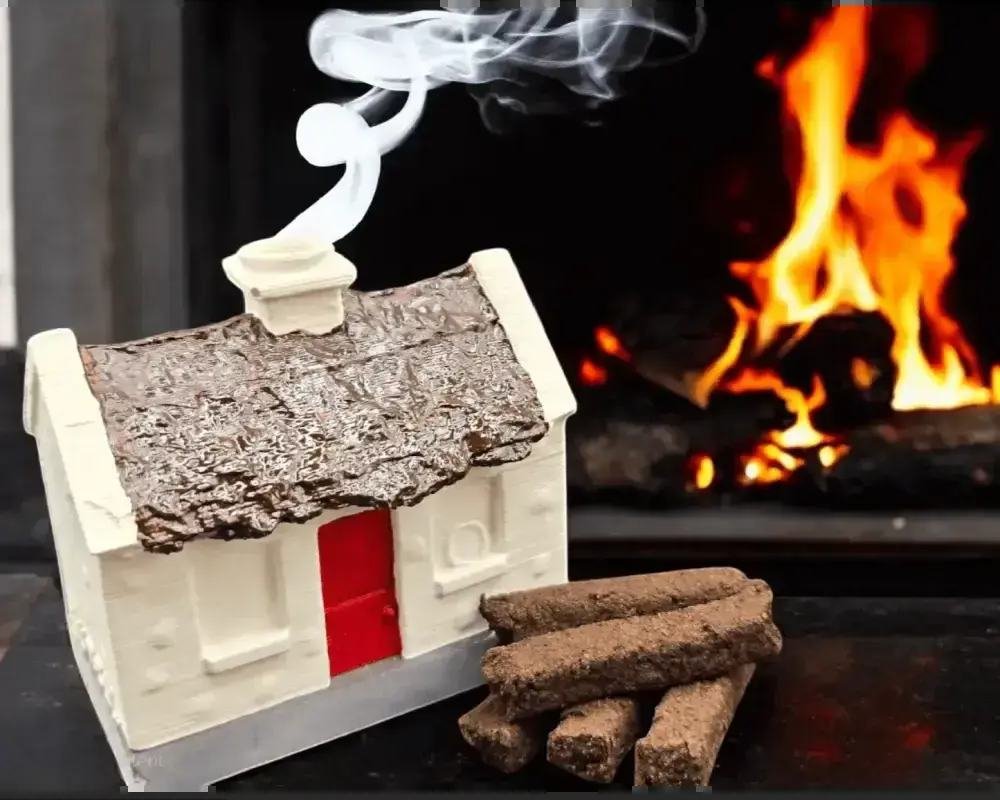
A small white cottage burner with a dark roof and a red door, smoke rising from the chimney, turf sods in front and a fire burning behind.
Smoke rising from a hand-painted cottage burner, a replica of a small cottage in Rathkeale, County Limerick. Photograph from the Aureal Aromatics shop.

Turf is peat, cut in sods from a bog and dried for the fire. In Ireland it was the ordinary fuel of rural houses: stacked at the gable, carried in a creel, and burned on the open hearth or in the range.

The smoke is unlike coal or wood. It is earthy, slightly sweet, and immediately familiar to anyone who grew up with it. For many people now living away from a turf fire, it is the smell that means home.

Earthy, slightly sweet, and immediately familiar to anyone who grew up with it.

On the smell of a turf fire
A whitewashed cottage with a large stack of long turf sods built against the gable.
Illustration. A turf stack, or reek, of long oblong sods built against the gable of a whitewashed cottage.

01

A fuel older than the hearth

Irish bogs are among the great peatlands of Europe, laid down over thousands of years. People have cut turf from them for at least a millennium, and probably longer. By the nineteenth and twentieth centuries it was the everyday fuel of the countryside, and the work of saving it shaped the summer in many parishes.

Commercial cutting on protected bogs is now tightly restricted, and a turf fire is less common than it once was. For a great many households, the smell has become a memory.

The history of turf — how the bogs were cut, and what the rules are now.

A cut turf bank in late summer, with sleán marks in the face and long sods at its foot.
Illustration. A cut Irish bog in late summer, with a turf bank, sleán marks, and long oblong sods at the foot of the bank.

02

Cut, footed, and brought home

The year’s fuel was won between spring and autumn. A bank was cleaned, the sods were cut with a sleán, spread to the weather, stood up in footings, and built into a clamp or a reek. Then they were drawn home in a creel, on a donkey, or on a cart. A wet summer could spoil the saving.

Cutting and saving turf — the sleán, the footing, and the bog in summer.


03

The fire that was kept in

On the open hearth, turf burned at floor level, under an iron crane and a hanging pot. At night the embers were raked together and covered — smoored — so the fire would still be there at breakfast. The smoke stayed in wool, in hair, and in the kitchen.

The turf fire and the hearth — the crane, the pot, and the smell.


04

A small sod, for the smell

A bag of turf for the grate is no longer an ordinary thing to buy. A miniature sod, lit on a piece of slate until it glows and then left to smoulder, is burned for the smell alone, for about half an hour, not to heat a room. The cottage in the photograph sits over that sod so the smoke leaves by the chimney.

The turf incense guide — how to light it, and how to do it safely. The sods, the slate and the cottage are sold by turfincense.com.

A hand-painted white cottage burner with a red door, beside a basket of turf sods, outdoors on a tree stump.
Photograph. The cottage burner and a creel of turf incense, from the Aureal Aromatics shop.

Notes

Four essays